SmartRings

A high-tech ring that promises to replicate many of the features found in the latest crop of smartwatches, but without strapping a brick to your wrist, is now one step closer to reality.

Here’s how to set yourself up for success in 2014

As the old saying goes: your goals don’t work unless you do. You will likely face bumps in the road and moments when you feel as though you’re not making progress. When this happens, remind yourself of all that you have done, refocus, and keep going.

Science

“This is completely new and very much simpler than anything that has been done before,” said Andrew Hodges , a mathematical physicist at Oxford University who has been following the work.

Flat. Like a streak across space. Thin. Stretched out. How come whenever we see galaxies, they always look like this

NASA has the answer. And it has something to do with how a ball of dough becomes pizza.

The Masks We Wear

The smiles and laughter we display are clever devices hiding our pains and sorrows we carry within us. While tears and heart break are displayed for all to see revealing the thin cracks of the mask that we wear, allowing a small portion of how we truly ache inside be seen from observers quietly watching for you to reveal yourself. - Se more..

Showing posts with label samsung. Show all posts

Thursday, 2 January 2014

Samsung Announced the Galaxy Camera 2

Samsung on Thursday announced the Galaxy Camera 2, the sequel to last year’s Galaxy Camera. It’s actually the same exact camera as the original, with some modest improvements to the software, as well as a bigger battery and NFC support.
The Galaxy Camera 2 features a 16-megapixel image sensor and 21x optical zoom lens. There are some physical changes, like a hinged flash, as well as a similar faux-like build to the Galaxy Note 3 .
Samsung has increased the number of Smart shooting modes to 28, and you can separate exposure and focus, controlling them via the camera’s rear touch display. The Galaxy Camera 2 runs Android 4.3 (Jelly Bean), which brings a host of improvements over Android 4.1 found in the original. But like its predecessor, since the Galaxy Camera 2 runs Android, you can download apps from Google Play such as Instagram, and upload or share images directly from your camera.
The camera’s display measures the same 4.8- inches as before, with 720p resolution. But the RAM has been increased to 2GB, and the processor is bumped up to a 1.6GHz quad- core chip. The battery is bigger now as well, at 2,000mAh, so you can record longer videos. Finally, Samsung has added NFC, which will let you do things like the tap the camera to share pictures with your phone.
Pricing and availability have not yet been announced. And though the camera works over Wi-Fi, there’s no word whether carrier- specific versions will be introduced. The camera will be shown at CES next week, where I suspect we’ll learn at least some of those details. For reference, the first Galaxy Camera cost $449.99. Given the relatively minor improvements here, I think Samsung would be wise to choose a slightly lower price if it really wants the Galaxy Camera to take off.

Monday, 30 December 2013

Samsung's New Chips Could Put 4GB of RAM Into Every Phone

There's an inherent trade-off when designing a phone, between pure power and respectable battery life. Fortunately, Samsung's latest memory chips are so efficient that they could make 4GB of RAM in phones an industry standard—and make 4K phones a very real thing indeed.

The company's first 1GB low-power DDR4 memory chip uses a higher bandwidth than its predecessors, running at 3.1Gbps to provide a 50 percent speed boost over existing DDR3-based chips. Not only that, but the new chips use 40 percent less power, too. Squeezing 1GB onto a single die, four of the chips layered together should provide the highest capacity mobile phone RAM currently available.

Samsung only says that the new memory will go into mass production some time in 2014, but it's intended for use in ultrabooks, tablets and high-end smartphones. Indeed, Samsung goes as far as explaining that "with the new chip, [we] will focus on the premium mobile market including large screen UHD smartphones... that offer four times the resolution of full-HD imaging." Yep, that's 4K smartphones.

The bottom line, then: your next phone (or at least the one after it) will likely rock 4GB of RAM and offer rather pointless resolution. Woo!

Source: Samsung

Samsung launches 110-inch U- HD TV for $150,000 in South Korea

Last year, Samsung and rival LG Electronics, the world’s top two TV makers, touted OLED as the future of TV. OLED screens are ultrathin and can display images with enhanced clarity and deeper colour saturation.
But Samsung and LG failed to make OLED TVs a mainstream that would replace the LCD television sets and still struggling to mass produce larger and affordable TVs with OLED. Meanwhile, Japanese media reported last week that Sony Corp. and Panasonic Corp. decided to end their OLED partnership.
Demand for U-HD TVs is expected to rise despite dearth of content while its price will likely come down faster than that of the OLED TVs. Much of the growth is forecast to come from China, a major market for the South Korean TV makers. Chinese TV makers have been making a push into the U-HD TV market as well.
According to NPD DisplaySearch, global sales of ultra-HD TV sets will surge from 1.3 million this year to 23 million in 2017. More than half of the shipments will be taken by Chinese companies between 2013 and 2017, according to NPD.
While Chinese TV makers have been seeking to boost sales of U-HD TVs with a lower price and a smaller size, Samsung’s strategy is to go bigger with a higher price tag. Samsung’s 110-inch U-HD TV measures 2.6 metres by 1.8 metres. It will be available in China, the Middle East and Europe. In South Korea, the TV is priced at 160 million won ($152,000) while prices in other countries vary.
Samsung said it received 10 orders for the latest premium TVs from the Middle East. Previously, the largest U-HD TV made by Samsung was 85-inch measured diagonally. The ultra-HD TVs are also known as “4K” because they contain four times more pixels than an HD TV.

Friday, 27 December 2013

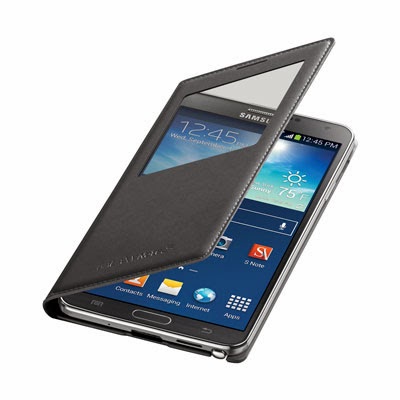
Samsung offers wireless charging, S-View flip cover for Galaxy Note 3

Samsung has combined two popular cover options into one with the release this week of the Wireless Charging S-View Flip Cover for the Galaxy Note 3. The S-View feature gives users access to their phone’s features without having to actually flip open the cover. Users can access information like the clock and phone status, accept or reject incoming calls, quickly access the camera, open the Action Memo menu and even navigate music.

Mated to the S-View cover is a wireless charging compatible back cover. The new cover will work with Qi-compatible charging pads so users can eliminate plugging and unplugging their device every time it needs a charge. The back snaps into place replacing the normal back cover to help keep the device slim and trim.

The new covers are available in black or white and will set buyers back $69.99.

Wednesday, 18 December 2013

Samsung Announces its own Standalone GamePad

Apple began allowing third-party gamepads on the iPhone with iOS 7, and Samsung is also upping its presence in the space after announcing its own gamepad (the not-so-creatively named ‘Smartphone GamePad’) for Android 4.1 phones.
Unlike the iPhone gamepads which attach themselves to the device, Samsung’s is standalone and uses a Bluetooth connection to link up with a smartphone — although Android 4.3- powered Galaxy phones enjoy more features, including NFC connect support.
The GamePad weighs in at 195g and features an eight-way D-Pad, two analog sticks, four action buttons and two triggers located on the shoulders of the device. The pad is accompanied by an app (‘the Mobile Console app’) through which users can browse and buy supported games.
The GamePad appears to support all Android smartphones, but some features — including a ‘Play’ button — are exclusive to the Samsung Galaxy family. The company points out that Galaxy device owners can hook their phone up to their TV using an HDMI cable or mirroring apps like Samsung’s AllShare service, and then replicate a home console experience using the GamePad.
Samsung says the GamePad is available now in “select” countries in Europe, although it has not revealed a price (we’ve contacted Samsung to try to get it). The company says the accessory will become available in other markets “in the coming weeks.”